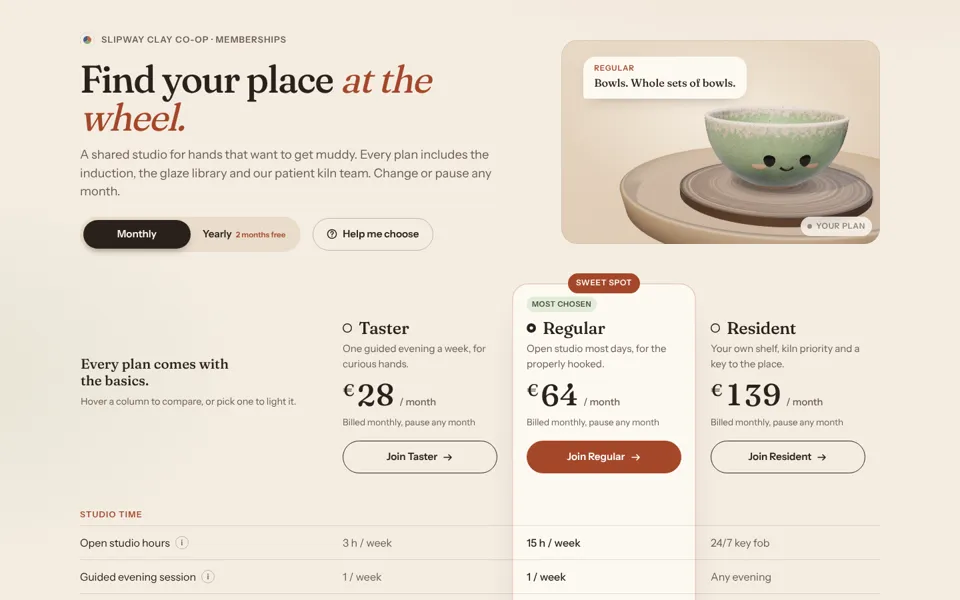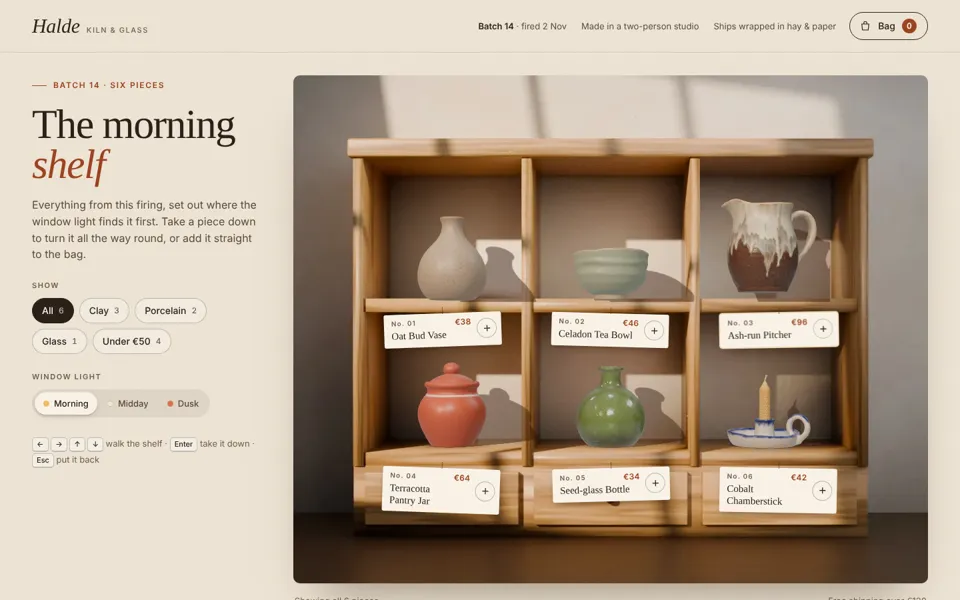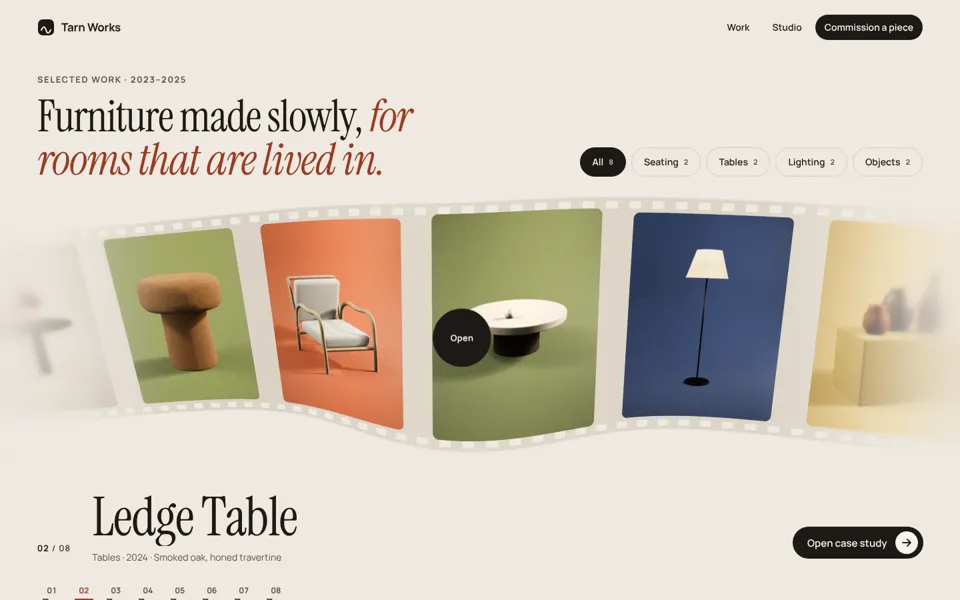
Site · Portfolio
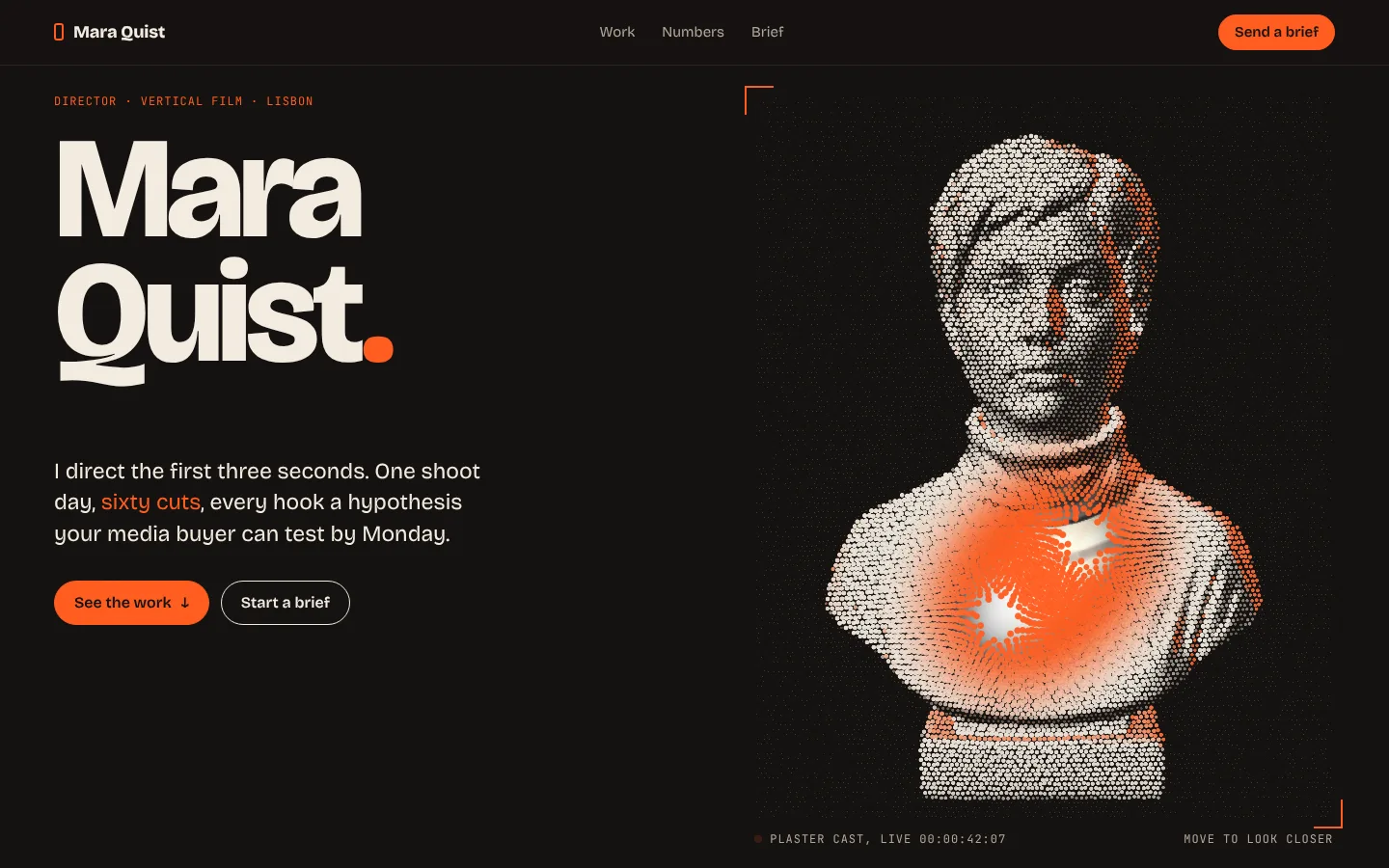
Mara Quist Director portfolio with a living halftone portrait
A portfolio where thousands of dots form the director's portrait, then regroup into phone frames playing the work.
What's in the prompt
- A full written spec: layout, tokens, every animation with its numbers, responsive rules
- The complete working code as the reference implementation
- Accessibility, reduced motion and fallbacks already handled
- A “Make it yours” checklist so your site looks like nobody else’s
- Type
- Site
- Built with
- HTML, CSS, JS · three.js 0.170.0
- Prompt size
- 69 KB
- Tags
- portfolio, webgl, personal site, video
- Updated
- 2026-11-26
Use it in three steps
- Copy the prompt with the button above.
- Paste it into your AI (Claude, Claude Code, ChatGPT, Cursor…) and add your edits.
- Launch the single
index.htmlanywhere: Cloudflare Pages, Netlify, GitHub Pages.
About the Mara Quist design
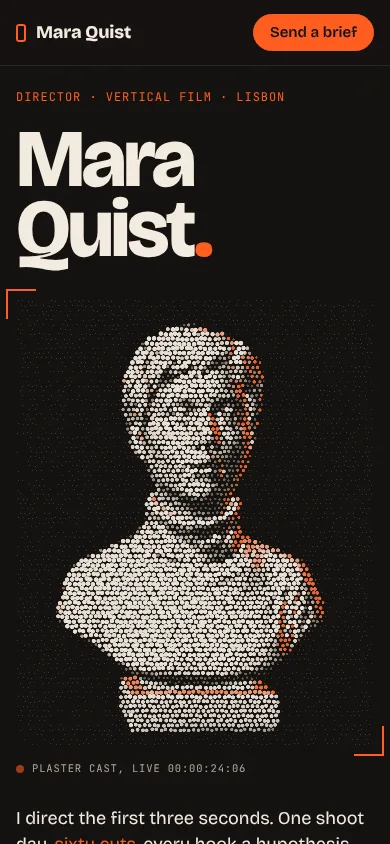
Mara Quist is a one-page portfolio for a fictional director of vertical video ads, set on warm ink with bone-white text and one tangerine accent. Bricolage Grotesque in heavy weights gives the name and numbers a poster scale, and JetBrains Mono labels the slate, captions and form. The signature is a plaster bust of the director that renders live in three.js and is redrawn every frame as about 18,000 halftone dots. The bust turns toward the cursor and a tangerine rim light shows as orange dots along its edge, which suits someone whose work is light, framing and the first three seconds of a shot.
The page opens with a film slate that counts to 100 and claps, then the dots burn in row by row to form the bust beside the name. Moving the pointer parts the dots and reveals the shaded render underneath. Scrolling sends the same dots flying into the outlines of six 9:16 phone frames, where stills and two short video loops develop inside them; filter chips and a player dialog show each piece. The dots then become three big numbers and finally the words Book the shoot, above a brief form that validates, estimates turnaround and builds a summary.
Good for
- Video directors and editors: the phone frames show vertical work at its real ratio
- Photographers: the prompt suggests 3:2 contact-sheet frames instead
- Content creators and podcasters: square cover tiles can replace the phones
- Small production studios: the brief form collects jobs and estimates lead time
- Personal brands with a strong portrait: the halftone bust makes the person the hero
How Mara Quist is built
- Halftone from a live render target. A plaster bust GLB renders each frame into an off-screen 480×600 target (320×400 on mobile), and about 18,000 screen-space dots sample its luma so dot size is cell × (.12 + 1.05·√lum).
- Rim light read as colour. A tangerine rim light (#ff5b1f at 5.5) and a cool fill light the bust; the vertex shader turns red-minus-blue into a 'warm' value, so the lit edge shows as orange dots as the bust turns on its spring (k 38, damping 9).
- Brush lens. Ten decaying pointer trail points push dots apart within about 110px, and a screen quad over the portrait reveals the real shaded render inside the brush.
- Dots that follow DOM rects. Each dot has four targets: the portrait grid, a place in one of six 9:16 phone frames, and text samples of the stats and the 'Book the shoot.' line, with rects read from getBoundingClientRect every frame.
- Slate preloader and burn-in. A film slate counts to 100 and claps, then dots burn in row by row over 2200ms with a tangerine ember sin(π·sI) on the moving front.
Images, video and 3D
A 411 KB meshopt GLB of a plaster bust made with an image-to-3D tool, a black-and-white portrait photo, six 9:16 work stills in two sizes, and two short muted MP4/WebM loops made with an image-to-video tool. Replace the bust with your own 3/4 studio shot converted to GLB, use your own vertical work, and keep exactly six pieces because the shader has six rect slots.
Build it with Claude
Paste the prompt and ask Claude for index.html, but treat the claude.ai preview as a check of the fallback only: the GLB and media are local files and the prompt itself says to serve over http. Check the filter chips, the player dialog with arrow keys, and the brief form's turnaround estimate, then run the downloaded file next to your assets.
Claude guide →Build it with Claude Code
Create index.html with an assets/ folder holding bust.glb, portrait.webp, work-1…6 and work-1…6-lg WebPs, and pour/dance MP4 and WebM. Serve it with npx serve or python3 -m http.server, since the GLB and the canvas text sampling need same-origin; ask Claude Code to confirm in a headless browser that ?nogl shows the photo and solid type and that the dots land inside all six phone frames at 390 and 1440.
Build it with ChatGPT
The prompt describes two scripts and a long vertex shader, so ask ChatGPT to deliver the classic site script and the module stage separately, or to use canvas. Expect a follow-up on the text sampling: check that it draws each [data-dots] element with its computed font, letter-spacing and line-height, and resamples on resize.
ChatGPT guide →If it doesn’t work
- The bust never appears and the page sits on the slate: GLB loading fails from file://; serve the folder over http, and keep the 7s slate timeout so the page still opens.
- Dots drift off the type after a resize or font load: resample the [data-dots] text on resize (debounced 150ms) and read the target rects every frame.
- The silhouette has a grey box around it: compute lum as luma × alpha from the render target so the transparent background produces no dots.
Questions about Mara Quist
Can I use my own face for the Mara Quist bust?
Yes. The prompt suggests a clean 3/4 studio shot on light grey, converted with an image-to-3D tool and compressed with meshopt. Keep the 4:5 frame and the coloured rim light so the dots still pick up a lit edge.
What do visitors see with reduced motion or no WebGL2?
The canvas is hidden and they get the black-and-white portrait with its caption, the numbers and call to action as solid type, and the work stills visible from the start. Videos do not autoplay.
Make it yours
This prompt rebuilds one exact design. If everyone ships it unchanged, the sites will look alike. Change these lines before you paste it. Each change is one edit to the prompt. The structure and the interactions stay intact.
- Person and offer. Swap "Mara Quist", "Lisbon" and "I direct the first three seconds" for your own name, city and one-line promise. Keep the name to two short words so the h1 stays on two lines, and keep the lead under 25 words.
- The sculpture. The live object the dots sample is the signature. Generate your own: a bust of you in plaster, bronze or terracotta. Or swap the bust for an object that stands for your work, such as a camera, a microphone, a trophy or a product. Use a clean 3/4 studio shot on light grey, image→3D, then meshopt. Keep the 4:5 frame and the tangerine rim light so the dots still pick up a coloured edge.
- What the dots become. Keep the four-stage chain, but re-aim the middle: 3:2 contact-sheet frames for a photographer, square cover tiles for a podcaster, or specimen cards for a type designer (change the B aspect and the corner radius). Swap the CTA word for your own two- or three-word call.
- Palette. Replace
--ink,--boneand--tang, and the rim light colour with them. Keep--mutedon ink and the button text on the accent at ≥ 4.5:1. Examples: forest / chalk / signal yellow, or navy / paper / coral. - Type pairing. Swap Bricolage Grotesque + JetBrains Mono for another heavy grotesk and a mono, for example Familjen Grotesk + IBM Plex Mono, or Unbounded + Space Mono. The dots copy the computed font automatically.
- The work. Use six of your own pieces. Keep exactly six, because the shader has six rect slots. Put real muted 9:16 clips in place of the stills where you have them, at 540w and under 400 KB each.
- Numbers and slate. Put three true facts in the stats (a count, a speed, a loyalty figure, each under 6 characters) and your own production names on the slate.
- Brief form. Rename the fields to your intake questions and set the turnaround formula to your real lead times.
Tell your AI: "Build exactly as specified, but with these changes: …", then list your edits.