Hero · Hero section
Velum Glass cryptex hero you can actually solve
A frosted-glass cryptex in live 3D: turn the rings, solve the riddle and it unlocks a code.
What's in the prompt
- A full written spec: layout, tokens, every animation with its numbers, responsive rules
- The complete working code as the reference implementation
- Accessibility, reduced motion and fallbacks already handled
- A “Make it yours” checklist so your site looks like nobody else’s
- Type
- Hero
- Built with
- HTML, CSS, JS · three.js 0.170.0
- Prompt size
- 78 KB
- Tags
- three.js glass, interactive hero, puzzle, gamification
- Updated
- 2026-11-26
Use it in three steps
- Copy the prompt with the button above.
- Paste it into your AI (Claude, Claude Code, ChatGPT, Cursor…) and add your edits.
- Launch the single
index.htmlanywhere: Cloudflare Pages, Netlify, GitHub Pages.
About the Velum design
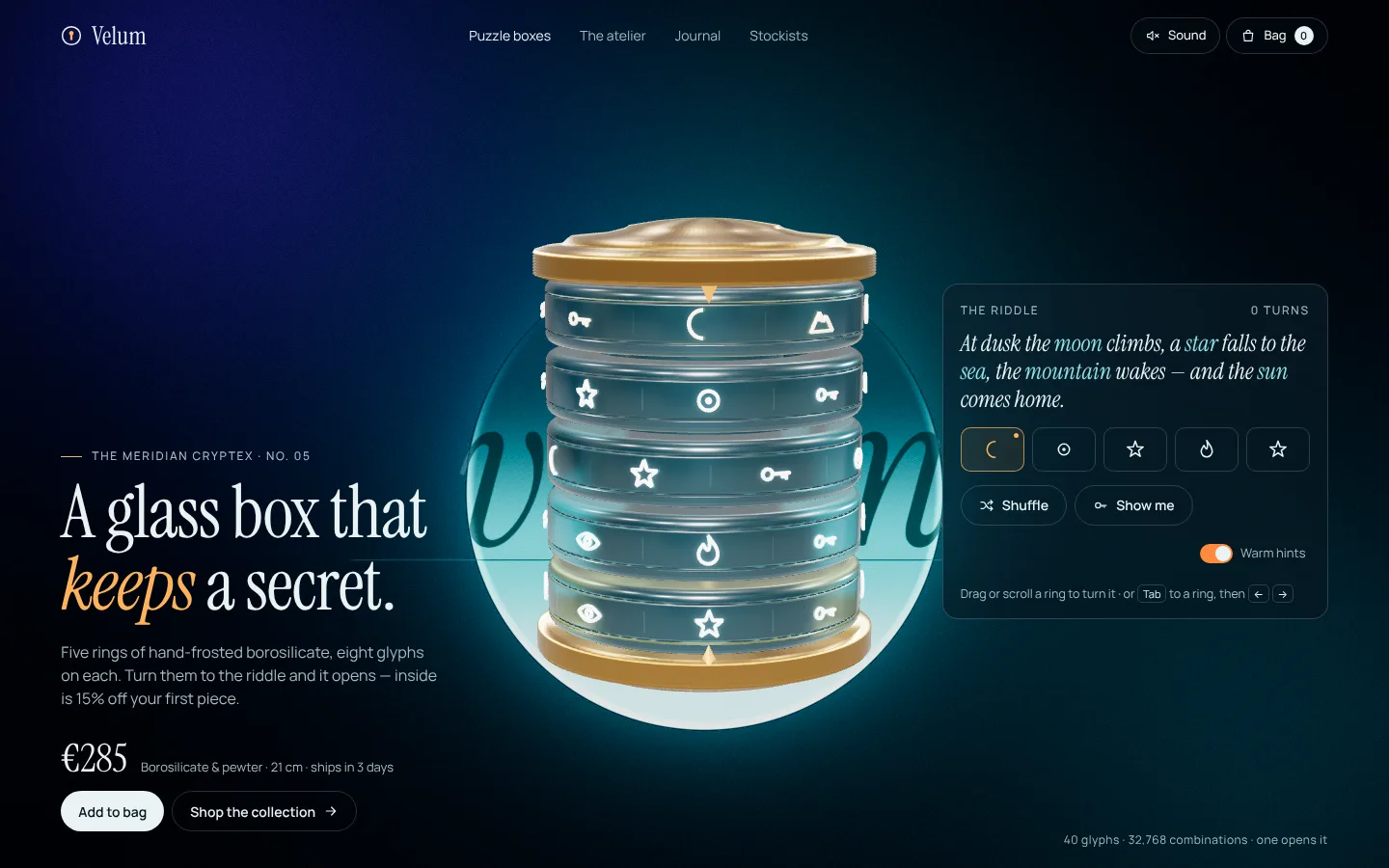
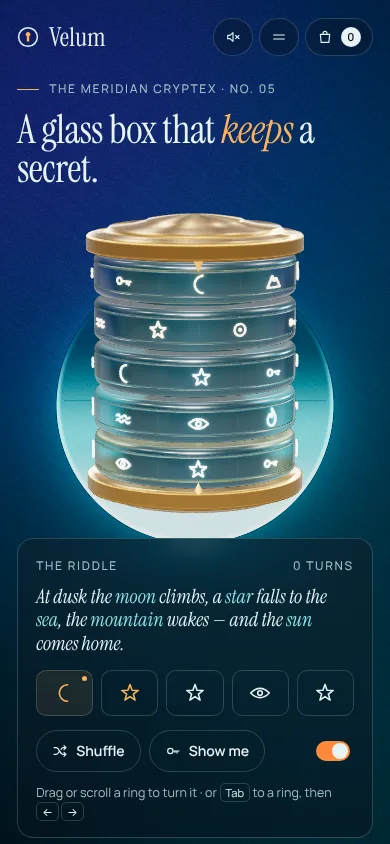
Velum is a one-screen hero for a fictional maker of frosted glass puzzle boxes, built around a puzzle the visitor can actually solve. A three.js cryptex of five frosted aqua glass rings stands in the middle, each ring engraved with eight glowing glyphs and held between knurled brass caps. Behind it a lantern orb and a large italic wordmark are painted into the 3D backdrop so the glass refracts them. The palette is deep blue-black with aqua for the idle state and amber for the unlocked state, with Instrument Serif for the headline and riddle and Manrope for the interface.
A preloader draws the glyphs in a row while a counter runs. The page then shows the headline and buy block on the left, the cryptex in the centre and a riddle panel on the right that names five glyphs. Visitors drag, scroll or arrow-key each ring, and it settles into place with a small spring overshoot; optional sound adds a glass tick. Lining up moon, star, sea, mountain and sun opens the cryptex: the rings part, the caps slide apart and amber light pours out of the seams. The panel then reveals a 15% code that is applied to the bag, and the hero price drops.
Good for
- Puzzle, game and escape-room brands: the hero is a playable puzzle
- Product launches with a promo code: solving the puzzle is the reward
- Jewellery and lock makers: the prompt suggests brass combination wheels
- Tea or spice shops: stacked ceramic tins can replace the rings
- Event invitations or secret menus: the riddle can unlock any hidden offer
How Velum is built
- Transmissive glass rings. Five LatheGeometry rings (outer radius 1.0, inner 0.64, height 0.40 with two V-grooves) use MeshPhysicalMaterial with transmission 1, roughness .24, IOR 1.5, dispersion .35 and an aqua attenuation colour.
- Engraved tube glyphs. Each SVG glyph is sampled every 1.6 units with getPointAtLength, wrapped onto radius 1.018 and turned into a TubeGeometry; the material is flagged transparent so the glass does not refract its own engraving.
- Refracted shader backdrop. A camera-locked plane paints the ink ground, colour blobs, a lantern orb and the italic 'velum' wordmark, so it lands in the transmission pass and the rings bend it.
- Detent springs. Each ring settles on a 45° detent with a spring (k 170, c 16, about 9% overshoot) at 1/120 s sub-steps; drag, a 48px wheel step, taps and arrow keys all move it.
- Unlock sequence. When the rings read moon, star, sea, mountain, sun, an open spring (k 38, c 10.5) parts the rings from 0.045 to 0.145, slides the caps apart, lights the seams and turns the orb amber, then applies the VELUM15 code to the bag.
Images, video and 3D
Only three 400×400 product tiles for the reveal (tessera, orrery and hexad WebP, about 35 KB together); the cryptex, glyphs, orb and wordmark are generated in code. Replace the tiles with your own product photos or AI-generated images in one consistent light and crop.
Build it with Claude
Ask Claude for the single index.html and play the puzzle in the preview; if WebGL is blocked there, the playable SVG cryptex uses the same controls. Use Show me to confirm the unlock fires, then check the bag shows the −15% line and the hero price drops from €285 to €242.
Claude guide →Build it with Claude Code
Make a folder with index.html and assets/ for the three tiles, and serve it with npx serve so the unpkg module import and images load like production. Ask Claude Code to test ?nogl for the SVG version, step each ring with the arrow keys to confirm aria-valuetext names the glyph, and check the stage refits when the reveal replaces the riddle panel.
Build it with ChatGPT
Ask ChatGPT to write it in parts: the ring, glyph and cap geometry, the backdrop shader, the spring and input logic, and the panel, bag and SVG fallback, in canvas if available. Follow up on the hit boxes: they must be recomputed every frame from each ring's projected silhouette, or drags and focus rings will not line up with the 3D rings.
ChatGPT guide →If it doesn’t work
- The glass shows a blurry double of its own glyphs: mark the glyph tube material transparent so it stays out of the transmission render.
- The orb and wordmark do not refract: the backdrop must be an opaque plane inside the scene that fills the frustum, not a CSS layer behind the canvas.
- Attract mode accidentally solves the puzzle: the idle ring turns every 2.4 s must never move into the answer, and Shuffle allows at most one correct ring.
Questions about Velum
What is the answer to the Velum cryptex?
The riddle names five glyphs in order from top to bottom: moon, star, sea, mountain and sun. Line those up and the cryptex opens; the Show me button turns each ring to its answer if a visitor gets stuck.
Does the puzzle work without WebGL?
Yes. With no WebGL2, a failed three.js import, ?nogl or a lost context, a playable SVG cryptex appears in the same stage with the same controls, state and reveal.
Make it yours
This prompt rebuilds one exact design. If everyone ships it unchanged, the sites will look alike. Before you paste it, change these lines so the result is yours. Each change is one edit to the prompt; the structure and the interactions stay intact.
- Brand and offer. Swap "Velum", the Meridian Cryptex, €285 and VELUM15 for your own product, price and reward (a free sample, early access, a hidden menu item). Keep one product, one price and one code so the buy block and the reveal stay balanced.
- The puzzle object. The cryptex is the signature. Keep five rings on springs and the reveal, but change the object: brass combination-lock wheels, a stack of ceramic tea tins, a wooden ring puzzle, a dial safe seen front-on. Change the ring material (wood = roughness .6 and no transmission; ceramic = clearcoat glaze) and the caps to match.
- The glyphs and the riddle. Replace the eight glyph paths with eight from your world (tea leaves, notes, planets, letters of your brand) and rewrite the riddle so it names your five answers in order. Keep paths simple, stroked, in a 100-unit box.
- Palette. Replace ink, aqua and amber and the orb's three colours. Keep muted text ≥ 4.5:1 on the ground colour and keep one warm "unlocked" colour distinct from the idle colour.
- Type pairing. Swap Instrument Serif + Manrope for another display serif or italic face with a plain sans; the wordmark behind the glass should use the display face.
- Backdrop. Replace the lantern orb with your own light source: a low sun band, a window of light, a neon ring. It must stay behind the object so the glass has something to refract.
- Images. Replace the three collection tiles with your own product photos, or generate them in one consistent light, crop and background, at 400×400 webp.
- Copy. Rewrite the headline, lede and reveal in your own voice, and say plainly what the reward is.
Tell your AI: "Build exactly as specified, but with these changes: …", then list your edits.