Site · 3D & WebGL
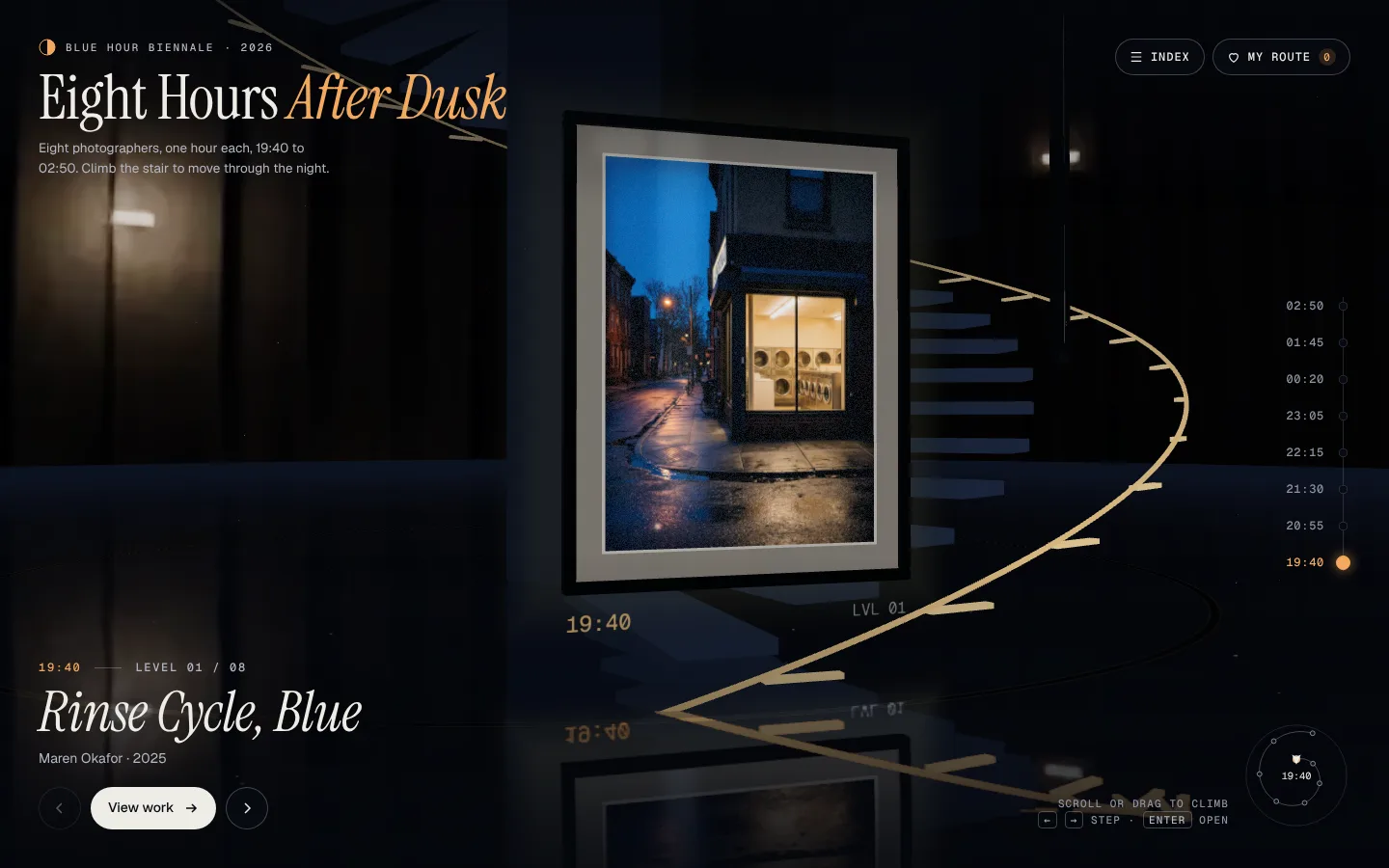
Eight Hours After Dusk WebGL photo exhibition on a rising spiral
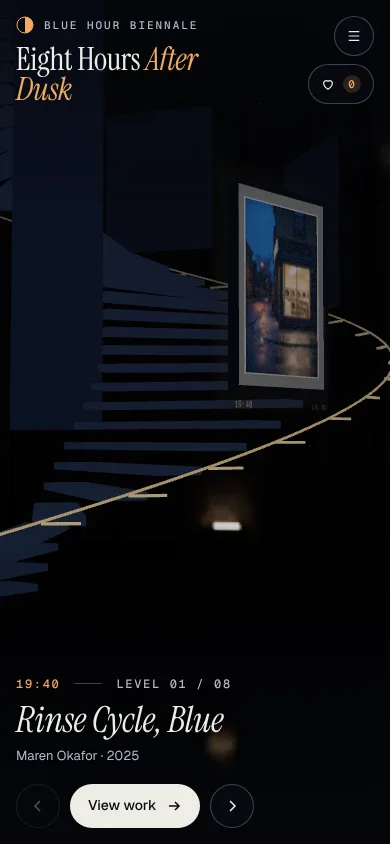
A photography exhibition hung as real framed objects on a spiral stair in a foggy hall. Click a frame and the camera flies to it.
What's in the prompt
- A full written spec: layout, tokens, every animation with its numbers, responsive rules
- The complete working code as the reference implementation
- Accessibility, reduced motion and fallbacks already handled
- A “Make it yours” checklist so your site looks like nobody else’s
- Type
- Site
- Built with
- HTML, CSS, JS · three.js 0.160.0
- Prompt size
- 89 KB
- Tags
- three.js, webgl gallery, 3d carousel, portfolio
- Updated
- 2026-11-26
Use it in three steps
- Copy the prompt with the button above.
- Paste it into your AI (Claude, Claude Code, ChatGPT, Cursor…) and add your edits.
- Launch the single
index.htmlanywhere: Cloudflare Pages, Netlify, GitHub Pages.
About the Eight Hours After Dusk design
Eight Hours After Dusk is an online exhibition for a fictional photography festival, built as a climb up a spiral staircase in a concrete stairwell. Each of eight night photographs hangs as a framed object, one per hour from 19:40 to 02:50, so going up the stair moves you through the night. The palette is near-black blue with a sodium-lamp amber for the handrail, focus rings and current hour, and a pale cyan for works you save. Instrument Serif italics give titles a gallery-label feel, with Geist and Geist Mono for captions and data.
After a short loader, the camera rises from a rippling reflection pool to the first level. Scrolling, dragging or pressing the arrow keys climbs the helix and snaps to each print; the focused work is sharp while the others blur and sink into fog. An hour rail on the right and a small spiral minimap show where you are. Clicking a print flies the camera to it and opens a panel with the title, artist, medium, size and notes, with earlier and later links and an Add to my route button. An Index view lists every work as a plain grid, which is also the fallback without WebGL.
Good for
- Photography festivals and shows: the ordered climb suits a series with a sequence
- Artist portfolios: eight to ten works read clearly as levels on the stair
- Museums with online collections: the DOM index keeps every work accessible
- Book or zine launches: chapters can replace hours as the level labels
- Architecture or interior studios: the rendered room can show a real space
How Eight Hours After Dusk is built
- Helix travel with snap. Eight prints sit on a spiral at STEP 0.95 rad, radius 3.3 and RISE 1.15 per level. Wheel, drag and arrow keys push a target value that the camera eases toward with 1 − exp(−dt·3.6) and snaps to the nearest level after 160ms idle.
- Mip-bias depth of field. The print shader samples texture2D(map, uv, uBlur) with uBlur = min(4.5, d·1.9) for distance from the focused level, plus desaturation and fog, so far prints blur and grey out without any post-processing pass.
- Rippled planar reflection. A Reflector disc at the foot of the stair distorts its projective UVs with a ring buffer of 24 analytic ripples, fed by the pointer and an ambient drip every .7–1.8s.
- Procedural framed objects. Each work is built from a mat board, bevel strips, RoundedBoxGeometry moulding, a backing box and an additive glass sheen plane, with a halo behind tinted to the photo's sampled average colour.
- One 360° plate as room, light and reflection. A 2048×1024 equirectangular Cycles render is mapped inside a sphere and also run through PMREM as scene.environment, so the frames and glass reflect the same stairwell.
Images, video and 3D
Eight 900×1200 night photographs (under 120 KB each) and one hall-360.webp equirectangular render of a concrete stairwell. Use your own photo series or generate one with an AI image tool in a single consistent look, and render a new 360° room in Blender (equirect camera, low samples plus denoise) to change the mood.
Build it with Claude
Ask Claude for the complete index.html; the preview will not have your local photos or the 360° plate, so expect empty frames or the list fallback there. Check the parts that do not need assets: the hour rail, keyboard stepping that queues against the target level, the detail panel focus trap and the My route counter.
Claude guide →Build it with Claude Code
Put the eight h*.webp photos and hall-360.webp in assets/, ask Claude Code to build index.html, and serve the folder with python3 -m http.server so textures load without CORS errors. Ask it to confirm in a headless run that the handrail passes below the prints, that the index view pauses rendering, and that blocking WebGL2 switches to the flat list within 9 s.
Build it with ChatGPT
Ask ChatGPT to split the output into the classic app-shell script and the 3D module, written in separate replies or in canvas, since the prompt defines a window.App contract between them. Follow up on the reflection: check that it really uses Reflector with the ripple shader and that the print shader skips tone mapping so the photos keep their colour.
ChatGPT guide →If it doesn’t work
- The handrail cuts across the photographs: it must run at radius 4.0 and at y = p·RISE − frameH/2 − .2, which keeps it under each print.
- Prints look washed out or too contrasty: the print ShaderMaterial should skip tone mapping while the rest of the scene uses ACES, otherwise the photographs shift colour.
- The page is a black screen when the CDN or WebGL2 fails: the DOM list must be the data source and App.fallback() has to fire if the module does not register within 9 s.
Questions about Eight Hours After Dusk
Does Eight Hours After Dusk use any 3D model files?
No. The frames, stair treads, handrail and water are all built in three.js code. The only images are the eight photos and one 360° render of the stairwell.
Can I use more than eight photos on the stair?
The prompt suggests keeping 6 to 10 works so the helix stays readable. More levels means a taller climb; you add list items in the DOM and the helix, rail and minimap are built from that list.
Make it yours
This prompt rebuilds one exact design. If everyone ships it unchanged, the sites will look alike. Before you paste it, change these lines so the result is yours. Each change is one edit to the prompt; the structure and the interactions stay intact.
- Exhibition and premise. Replace the Blue Hour Biennale and "one photograph per hour of the night" with your own show and an ordering idea that suits a climb. Examples: twelve months of a year, the floors of a building, a river from source to sea, chapters of a book, a career from first job to last. Keep 6–10 works so the helix stays legible, and keep a short ordered label per level in place of the hour (month, floor, km, chapter).
- The stair itself. The rising helix is the signature. Re-theme it without changing the travel maths. Some options: - A library spiral: oak treads, a brass rail and
STEP 0.7for a tighter turn. - A lighthouse interior: whitewashed treads, a red rail and a cyan lamp strip. - A gallery ramp, Guggenheim-style:RISE 0.6,STEP 0.5, a continuous tube in place of treads. - A mine shaft: rusted grating and a yellow rail.
Change the rail colour, tread colour and the STEP/RISE pair together.
- The room. Render your own 360° plate in Blender Cycles (equirect, about 2048×1024, low samples plus denoise) that matches the new theme: library stacks, a tiled lighthouse shaft, a white museum rotunda, a brick mill. The same file lights the frames and fills the reflection, so a warmer or brighter room changes the whole mood.
- Frames. Swap the black anodised moulding and white mat to fit your work. Options: natural oak with no mat for prints, gilded moulding for paintings, a borderless float mount with a 2 cm shadow gap for contemporary photos, or a lightbox (emissive print, no glass) for transparencies.
- Palette. Replace
--amber, the fog colour and--inkwith your brand's lamp colour and night colour. Keep--mutedat 4.5:1 or better on--ink, and keep the accent readable as text on the panel. - Type pairing. Swap Instrument Serif + Geist + Geist Mono for another display serif and grotesk with a monospace for labels. For example: Fraunces + Inter Tight + IBM Plex Mono, or Cormorant + Manrope + JetBrains Mono.
- The works. Replace the eight images and their
data-*fields with your own collection. If you generate them, shoot the series in one language: one lens, one grade, the same grain, real places and objects, nothing symmetrical or glossy. Write alt text that says what is in the frame. - Copy voice. Rewrite the lede, the work notes and the empty state in your curator's voice. Be specific about who, where and why ("eleven minutes before someone switched them off"), not generic ("a stunning exploration of light").
Tell your AI: "Build exactly as specified, but with these changes: …", then list your edits.