Section · Timeline
Ullbreen History timeline told as a 3D ice core
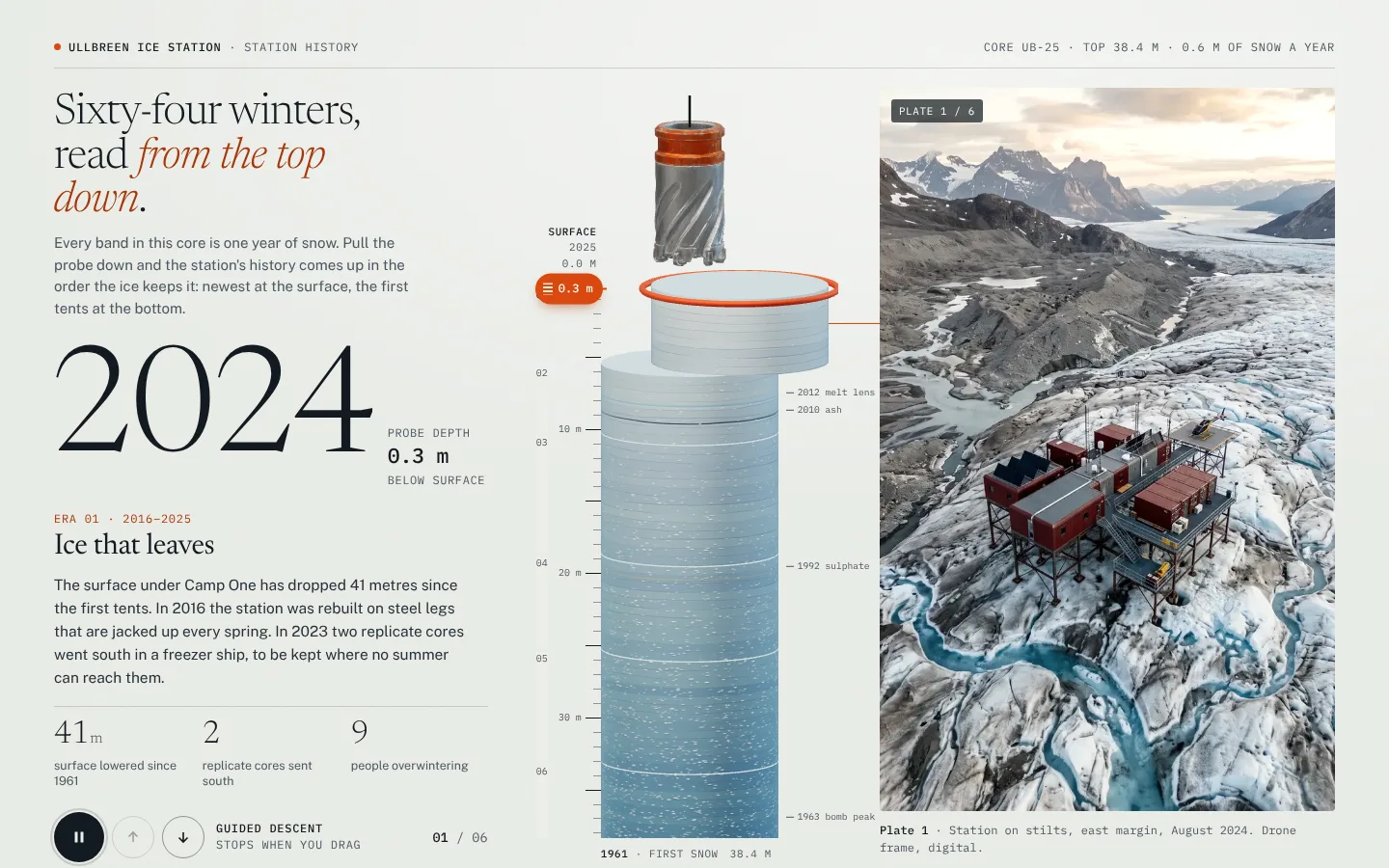
Drag a probe down a live 3D ice core, one band of snow per year. Each era slides out of the core, the year rolls like an odometer and its photo opens.
What's in the prompt
- A full written spec: layout, tokens, every animation with its numbers, responsive rules
- The complete working code as the reference implementation
- Accessibility, reduced motion and fallbacks already handled
- A “Make it yours” checklist so your site looks like nobody else’s
- Type
- Section
- Built with
- HTML, CSS, JS · three.js 0.170.0
- Prompt size
- 86 KB
- Tags
- timeline, about page, history, interactive
- Updated
- 2026-11-26
Use it in three steps
- Copy the prompt with the button above.
- Paste it into your AI (Claude, Claude Code, ChatGPT, Cursor…) and add your edits.
- Launch the single
index.htmlanywhere: Cloudflare Pages, Netlify, GitHub Pages.
About the Ullbreen design
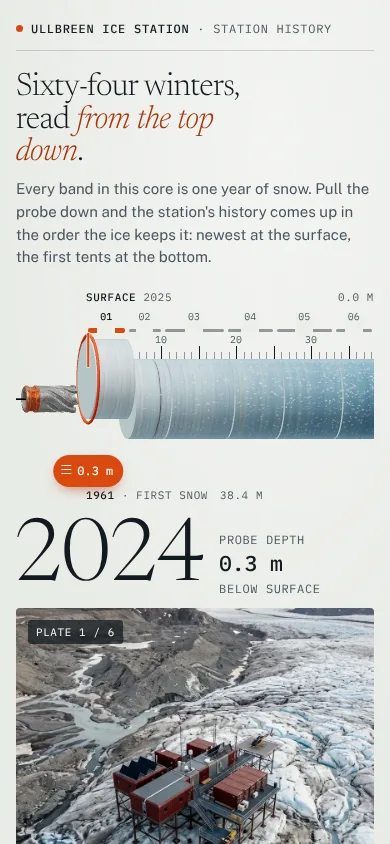
Ullbreen is a one-screen history timeline for a fictional glacier research station, titled 'Sixty-four winters, read from the top down.' The timeline is an ice core: at 0.6 m of snow a year, the snow of 1961 sits 38.4 m down and 2024 is at the surface, and the station's six eras are bands in that core. The ground is pale paper with ink and one signal orange kept for the probe and collar. Newsreader sets the huge year, Public Sans the stories and IBM Plex Mono the instrument labels. The signature is that position on the core is real data, so moving through time also reads off an exact year and depth.
A live PBR ice core stands in the middle column, with a metal drill-head GLB hanging above it on its cable. Dragging the orange probe, scrolling over the core, clicking a band or using the arrow keys moves through the eras. When the probe enters a new era, that section slides out of the column and turns, the archive photo opens through a wavy strata-shaped mask, the year rolls like an odometer and three stats count up. A guided descent steps one era every 5.2 s, and on phones the core lies horizontally.
Good for
- Organisations with a long history: five to seven eras of uneven length read as real time
- Vineyards and farms: the prompt suggests a soil core with a charcoal fire layer
- Timber and forestry brands: a tree-ring log can lie horizontally instead of the ice
- Publishers or record labels: a stack of paper or vinyl can replace the core
- Museums and research groups: the dated horizons suit real markers from their own record
How Ullbreen is built
- Core as a data axis. sOf(v) = (2025 − v)/64 · L gives each year a distance down the core, depth is (2025 − v) · 0.6 m to one decimal, and the probe value is clamped to 1961.5–2024.5, so the readout is always a real year and depth.
- Sub-stepped probe spring. The probe spring (stiffness 150, damping 24) is integrated in 4 ms steps with dt capped at 250 ms; on release it projects the throw (velocity × 120 ms), rubber-bands ×0.3 past the ends and settles on that era's key year.
- DOM-aligned orthographic 3D. An orthographic camera in rig pixels puts the 3D core exactly on the DOM core rect; the core tilts .16 rad toward the viewer and its length is scaled by 1/cos(tilt) so the bands still meet the gauge ticks.
- Sections that pull out. Each era is its own 96-segment open cylinder with UVs remapped to its band of the strata canvas, and its own spring (k 170, c 22) moves the active section out 52px and turns it 0.9 rad while the orange collar rides with it.
- Strata-shaped photo mask. The incoming photo's clip-path polygon has 23 points per edge, rebuilt every frame for 820 ms, with edges wobbling by three seeded sines (frequencies 2, 5 and 11) that match the cut ends of the pulled-out section.
Images, video and 3D
Six 860×1152 WebP archive plates (about 100–200 KB each) whose film look ages with the era, from silver gelatin for 1961 to crisp digital for 2024, plus a 700 KB stainless drill-head GLB made with an image-to-3D tool and optimised with meshopt and WebP textures. Make your own plates with one lens and one light, letting the film stock age by era, and convert a clean grey-sweep product shot of your own tool to a GLB under 1 MB.
Build it with Claude
Ask Claude for the single index.html; the classic script runs the whole timeline, so the preview can show the 2D canvas core even without the 3D module or the photos. Check that the third bracket lands on 1997 at 16.5 m, that the stats count up with a real minus sign in −25 °C, that the play button pauses the guided descent, and that any drag stops it for good.
Claude guide →Build it with Claude Code
Place the six WebP plates and drill-head.glb in assets/ and serve with python3 -m http.server, because the GLB cannot load from file://. Ask Claude Code to confirm that at 900px and below the core turns horizontal with the drill at its surface end, that a mostly vertical swipe still scrolls the page, and that a module error leaves the 2D core fully working.
Build it with ChatGPT
Ask ChatGPT for the classic script first (data, 2D core, probe spring, inputs, era switch, mask and odometer) and the three.js module second, or use canvas. A common follow-up is bands that do not match the gauge: check that the orthographic camera works in rig pixels and that the core length is divided by cos(.16).
ChatGPT guide →If it doesn’t work
- The 3D bands drift away from the gauge ticks: use an orthographic camera in rig pixels and scale the core's length by 1/cos(tilt) so the tilt does not shorten it.
- The guided descent fights the visitor: run it only while 25% of the section is in view, the pointer and focus are outside it and nothing is being dragged, and stop it for good on any input.
- Slow devices drop frames: if more than 5 of the first 90 frames take over 70 ms, drop the pixel ratio to 1, stop the idle drift and render only when something changes.
Questions about Ullbreen
Is the Ullbreen ice-core data real?
The station, its eras and its stats are fictional. The depth rule is a fixed 0.6 m of snow a year, and the four horizons drawn into the ice (a 1963 bomb peak, 1992 sulphate, 2010 ash and a 2012 melt lens) are the kinds of markers glaciologists use to date real cores.
Can people use the timeline without a mouse?
Yes. The probe is a role=slider: up or left and down or right move one era, Shift with an arrow or PageUp/PageDown move one year, and Home and End jump to the surface or the bottom. The era brackets and arrow buttons are real buttons, and changes are announced in a polite live region.
Make it yours
This prompt rebuilds one exact design. If everyone ships it unchanged, the sites will look alike. Change these lines before you paste it. Each change is one edit to the prompt, and the structure and interactions stay intact.
- Brand and story. Swap Ullbreen Ice Station for your own long-running place: a family vineyard, a quarry, a lighthouse, an orchard, a coffee farm. Keep 5–7 eras with uneven lengths (that is what makes the bands read as time) and exactly three stats per era. Rewrite the depth rule to fit your material (cm of soil a decade, metres of rock an era).
- The core. The striped cylinder is the signature, so re-theme its material and keep the slide-out and the collar. Options: a soil core (loam, clay, gravel, a charcoal fire layer, roughness .8, no clearcoat), a tree-ring log lying horizontal (end grain on the cap, bark on the side), a sediment tube from a lake (varves, a pollen band), or a stack of vinyl/paper for a label or publisher. Replace the four horizons with real markers from your story.
- The object above it. Replace
drill-head.glbwith the tool that made your record: a soil auger, a corer, a cooper's adze, a wine thief. Generate a clean product shot (centred, grey sweep, 3/4 view), convert it image-to-3D, and optimise it to ≤ 1 MB with meshopt and WebP textures. - Palette. Replace paper, ink, muted and signal (
#d9480f). Signal must stay one loud working colour used only for the probe, collar, ring and leader. Keep muted and signal-ink text ≥ 4.5:1 on your ground, and retune the two strata albedo ramps to your material. - Type. Swap Newsreader / Public Sans / IBM Plex Mono for another serif display with a light weight (for the odometer), a plain sans and a mono for the instrument labels. Avoid Inter and Poppins.
- Photos. Generate six new plates of your own eras with one lens and one light, and let the film stock age with the era (silver gelatin → slide film → colour negative → 35 mm → early digital → crisp digital). No text in the images. Keep the shared CSS grade so they read as one archive.
- Voice. Write each era as a field note: a date, a number and one physical object people can picture ("gravel in the teeth at 2,540 m"). No "journey", no "legacy", no "unlock".
Tell your AI: "Build exactly as specified, but with these changes: …", then list your edits.