Site · Scroll storytelling
Tenfold Multiplane paper dioramas filmed by scroll
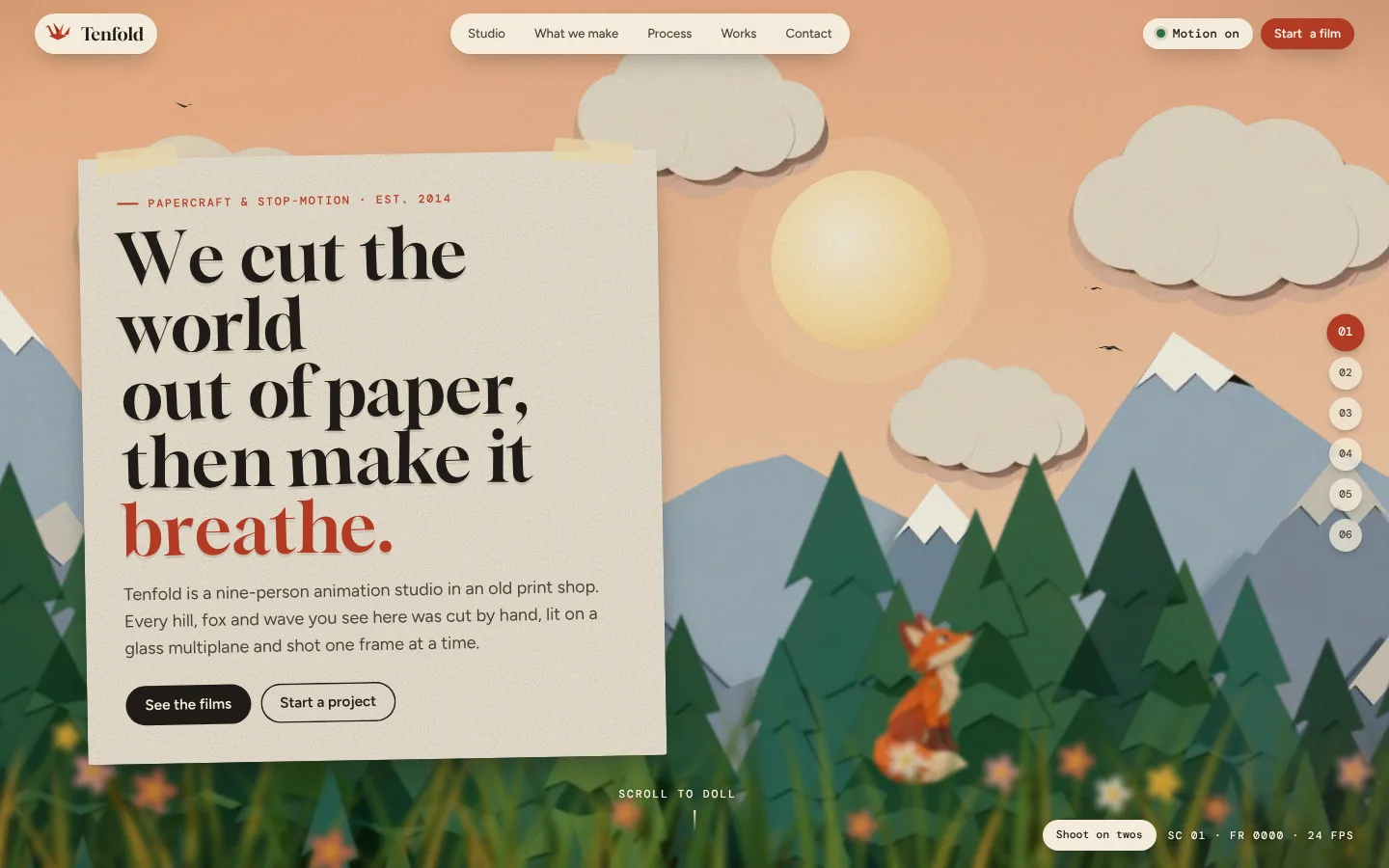
An animation studio site where scrolling dollies a camera through layered paper dioramas rendered in Blender.
What's in the prompt
- A full written spec: layout, tokens, every animation with its numbers, responsive rules
- The complete working code as the reference implementation
- Accessibility, reduced motion and fallbacks already handled
- A “Make it yours” checklist so your site looks like nobody else’s
- Type
- Site
- Built with
- HTML, CSS, JS · no libraries
- Prompt size
- 83 KB
- Tags
- parallax, scroll storytelling, agency, animation studio
- Updated
- 2026-11-26
Use it in three steps
- Copy the prompt with the button above.
- Paste it into your AI (Claude, Claude Code, ChatGPT, Cursor…) and add your edits.
- Launch the single
index.htmlanywhere: Cloudflare Pages, Netlify, GitHub Pages.
About the Tenfold design
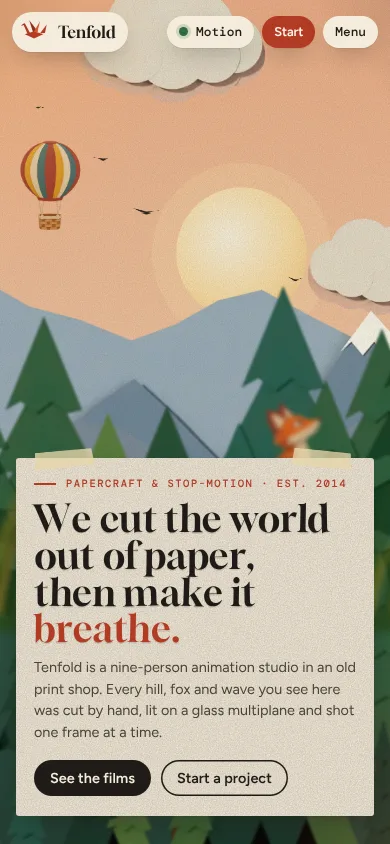
Tenfold is a one-page site for a fictional papercraft and stop-motion studio, filmed by a scroll-driven multiplane camera like the rigs used in classic animation. Each of six chapters is a diorama of five to nine cut-paper layers rendered in Blender, set under CSS skies with suns, moons, birds and a lighthouse beam. The palette is paper cream with a dark ink, a brick red accent and a deep blue for night scenes, with Gloock for poster-like headlines, Figtree for body copy and DM Mono for the slate readout. The look matches a studio whose craft is layered paper, and it never needs WebGL.
As a visitor scrolls, the camera dollies through the planes with real perspective, shifts focus between them and relights the sky, while headings pop up letter by letter like a pop-up book. At the end of each chapter the whole scene tears away along a jagged paper edge to reveal the next one already moving. The chapters cover the studio, what it makes, its process with a frame-budget calculator, a filterable reel of works with a details dialog, and a contact brief form. A Shoot on twos button drops the camera to 12 frames per second with a hand-made jitter.
Good for
- Animation and illustration studios: the layered camera shows craft before a single word
- Children's book publishers: pop-up headings and dioramas suit picture-book worlds
- Theatre and set designers: planes at different depths mirror stage flats
- Toy and game makers: each chapter can be a level or world
- Agencies wanting a non-WebGL showpiece: it runs on CSS transforms only
How Tenfold is built
- Multiplane dolly with true perspective. Each chapter is 5–9 transparent layers with a depth z; per frame every layer gets scale = z / (z − camZ) and a translate divided by that distance, so scrolling pushes the camera through the planes.
- Rack focus from focal distance. Each layer's blur is min(9, |1/d − 1/focus|·7) px, quantised to .25px and written only when it changes, so the focus shifts between near and far planes as the camera moves.
- Seeded torn-paper wipe. A 34-point jagged line with ±2.5% offsets travels up the viewport as the next chapter arrives; the outgoing scene is clipped above it with clip-path: polygon() and an SVG path draws the fibrous white core below.
- Pop-up letters. Headings split into letters that flip from rotateX(−100deg) to a slight ±1.8° tilt over 800ms with a 26ms stagger, triggered when 35% of the heading is in view.
- Shoot on twos. A toggle renders only every 83.3ms (12 fps) and adds a seeded per-layer boil of ±0.8px, while a slate shows SC · FR · FPS computed from scroll position.
Images, video and 3D
Seven paper planes rendered in Blender Cycles as transparent images (mountains, forest, grass, waves, village, clouds, lighthouse) plus four cut-out props (fox, bench, boat, balloon), about 0.8 MB in all. To re-theme, build cut-card layers in Blender with one shared camera and light and export each as its own transparent WebP; props can come from an AI image generator with the background removed.
Build it with Claude
Ask Claude for the complete index.html; without your 11 WebP layers the preview will show only skies, CSS suns and stars and the paper cards, which is still enough to test the scroll camera timing, the torn-paper wipe and the pop-up letters. Check that the Motion chip switches to static stacked dioramas and that the frame-budget calculator updates its film strip.
Claude guide →Build it with Claude Code
Place index.html next to an assets/ folder with the seven p_*.webp planes and fox, bench, boat and balloon WebPs. Plain images load from file://, but a local server (npx serve) keeps behaviour closer to production; ask Claude Code to scroll each chapter headlessly at 390 and 1440, confirm planes are lifted on phones so nothing hides behind the bottom card, and that there is no horizontal scroll.
Build it with ChatGPT
Ask ChatGPT to write it in sections (tokens and layout, the six scene configs, the camera loop and tear, then the UI: tabs, calculator, reel dialog, form) or use canvas. The scene configs are where follow-ups happen: ask it to list each layer's z, width, x and bottom values and check that z stays between 1.2 and 40 as the prompt advises.
ChatGPT guide →If it doesn’t work
- Scrolling stutters from constant repaints: only write the blur filter when the quantised value changes, and hide layers when d < .2 instead of scaling them huge.
- Empty sky shows under the scene on phones: the lifted planes need the gradient ground filler of height var(--lift) + 18% in each outdoor scene.
- The slate and buttons between cards can't be clicked: main, chapters and pins must be pointer-events: none, with cards, sheets and the footer turning it back on.
Questions about Tenfold
Is the Tenfold multiplane effect a video?
No. It is a live camera built from 11 still images moved with CSS transforms and blur every frame, so it reacts to scroll and pointer and keeps breathing when idle. It does not use WebGL.
What happens with reduced motion turned on?
The camera loop stops and each diorama is painted once as a static figure in its chapter, with cards no longer pinned and all letters, counters and steps shown in their final state. Visitors can also switch this with the Motion chip, which is remembered in localStorage.
Make it yours
This prompt rebuilds one exact design. If everyone ships it unchanged, the sites will look alike. Before you paste it, change these lines so the result is yours. Each change is one edit to the prompt; the structure and the interactions stay intact.
- Brand and offer. Swap "Tenfold Pictures" and its papercraft films for your own studio, shop or practice. Keep six chapters and one sentence per headline line so the cards still fit at 390px.
- The dioramas. The multiplane camera is the signature. Re-theme the planes, not the engine: a felt-and-wool world, layered cardboard cityscape, stained-glass panes, cut tin and lanterns, or a ceramic tile coastline. Keep 5–9 planes per chapter with z between 1.2 and 40, and render each plane as its own transparent image on one shared camera and light.
- The transition. Replace the torn-paper edge with a material from your world: a scissor-cut zigzag, a burnt edge, a folding shutter, a curtain hem. Keep the seeded jagged line and the rule that the next scene is already moving underneath.
- Palette. Replace paper, ink, red and blue tokens and each scene's sky pairs. Keep body text and the accent at ≥ 4.5:1 on the card colour.
- Type pairing. Swap Gloock + Figtree + DM Mono for a display serif or poster face, a plain sans and a mono for the slate. Pick a display face you have not seen on the last three sites you visited.
- Working UI. Rewrite the frame-budget calculator for your trade (a bake schedule, a print run, a renovation timeline) with your own formula, and replace the six works and their credits.
- Copy voice. Rewrite every headline and card in your own voice and be specific ("nine people, forty thousand paper parts", not "passionate creatives").
Tell your AI: "Build exactly as specified, but with these changes: …", then list your edits.